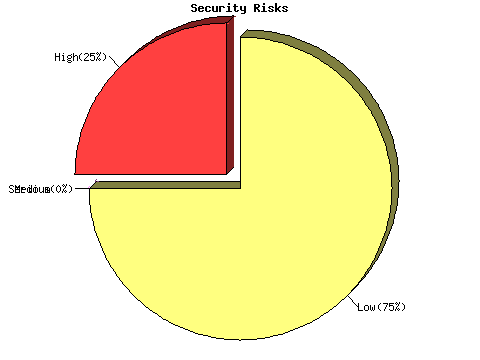
List of open ports :
Warning found on port auth (113/tcp)
The 'ident' service provides sensitives informations
to the intruders : it mainly says which accounts are running which
services. This helps attackers to focus on valuable services [those
owned by root]. If you don't use this service, disable it.
Risk factor : Low.
Solution : comment out the 'auth' line in /etc/inetd.conf
CVE : CAN-1999-0629
Warning found on port unknown (3128/tcp)
a web server is running on this port
Warning found on port unknown (3128/tcp)
an HTTP proxy is running on this port
Warning found on port unknown (3128/tcp)
The misconfigured proxy accepts requests coming
from anywhere. This allows attackers to gain some anonymity when browsing
some sensitive sites using your proxy, making the remote sites think that
the requests come from your network.
Solution: Reconfigure the remote proxy so that it only accepts coming
from inside your network.
Risk factor : Low/Medium
Warning found on port unknown (3128/tcp)
The Sambar webserver is running. It provides a webinterface for sending emails.
You may simply pass a POST request to /session/sendmail and by this send mails to anyone you want.
Due to the fact that Sambar does not check HTTP referers you do not need direct access to the server!
See http://www.toppoint.de/~hscholz/sambar for more information.
Solution : Try to disable this module. There might be a patch in the future.
Risk factor : High
Information found on port unknown (3128/tcp)
The remote web server type is :
Squid/2.2.STABLE1
We recommend that you configure your web server to return
bogus versions, so that it makes the cracker job more difficult
Information found on port general/tcp
Nmap found that this host is running Linux 2.2.14
Information found on port general/udp
For your information, here is the traceroute to 150.165.135.193 :
150.165.250.100
150.165.254.254
150.165.254.35
150.165.135.193
Warning found on port general/icmp
The remote host answers to an ICMP timestamp
request. This allows an attacker to know the
date which is set on your machine.
This may help him to defeat all your
time based authentifications protocols.
Solution : filter out the icmp timestamp
requests (13), and the outgoing icmp
timestamp replies (14).
Risk factor : Low
CVE : CAN-1999-0524